Counting to 61
Winning the trick and counting your Augen (points).
You already know which card wins (sticht). Now for the goal: take the trick (Stich) — and at the end count whether your party reaches 61. These two things decide the game.
Open the lesson in the app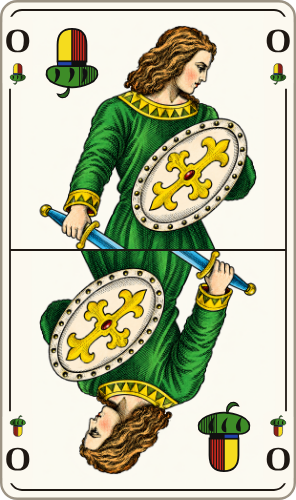
Whoever wins takes all four
Each of the four players lays one card — those are the four cards of one Stich (trick). Whoever wins it (see the Trumpf lesson) takes all four cards and lays them face-down on their own pile. And they get to lead the next trick straight away.
A game has 8 tricks — everyone starts with 8 cards in hand. Once the eighth trick is gone, it’s over, and then you count.
Säue count most, Neuner nothing
Not every card is worth the same. Here is how it goes:
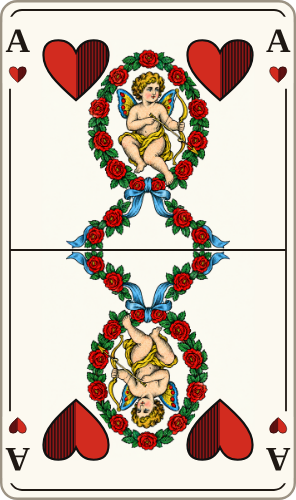
- Sau — 11 points
- Zehner — 10 points
- König — 4 points
- Ober — 3 points
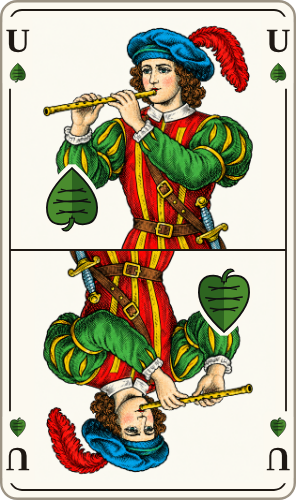
- Unter — 2 points
- Neuner, Achter, Siebner — 0 points
120 points add up all the cards and it’s 120 in the whole game
Ober and Unter are not air
The fat points sit in the Säue, Zehner and Könige — a single Sau already brings 11. But watch out: Ober and Unter are not “air”! The Ober counts 3, the Unter 2 — that’s always a little something. Truly empty are only the Neuner, Achter and Siebner with 0 points.
Remember it the other way round: empty is only Neuner, Achter, Siebner. Everything else — Sau, Zehner, König, Ober, Unter — brings you points on your pile.
61 wins — the opponents only need 60
At the end each party adds up its tricks: you and your partner against the two opponents. Your side needs 61 or more to win. The 120 points split up — 60:60 would be a tie, and so at 60:60 the opponents win. You have to go above, to at least 61.
≥ 61 wins the opponents only need 60
Under 31 is “Schneider”
Whoever stays under 31 points is “Schneider” — that costs a bit more to pay at the end. Exactly where the line sits comes in the settlement lesson. For now the 61 mark is enough — remember that one number.