Sauspiel or Weiter?
Judging whether a Sauspiel is worth the bid.
Even before a card is played, you have to decide: announce a Sauspiel — or pass (Weiter). It comes down to a look at your own hand: is it strong enough for the game, or would you rather let someone else go first?
Open the lesson in the app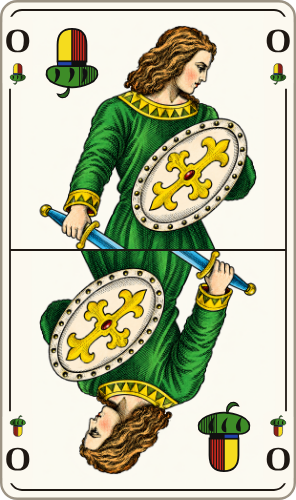
Whoever sits left of the Geber starts
Before playing, everyone gets a turn once — round the table, starting with whoever sits left of the Geber (the dealer). And you either announce a Sauspiel or you pass.
The three games of a default table have a ranking: Rufspiel < Wenz < Solo — a Wenz being a solo where only the four Unter are trump. A higher announcement beats a lower one — whoever wants the Solo outbids the Sauspiel. If you open with the Sauspiel, someone can still overbid you.
Then the hand is scrapped
If all four pass, nobody wants to play — then the hand is zammgschmissn (thrown in): no game, no points. Nothing happens, deal anew. So passing is no disgrace — just an honest statement about your hand. (If the table plays Ramsch — a house rule — the hand is not thrown in: it is played out, everyone for themselves, and whoever ends up with the most Augen pays.)
Ober, Unter, total trumps
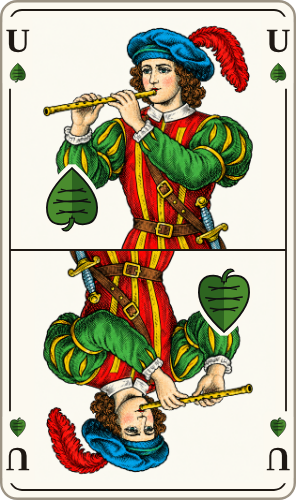
For the Sauspiel you look at your trump quality — and in this order: first the Ober (the highest trumps), then the Unter, and then the total trumps (all Ober, all Unter and every Herz card).
And all of that only from your own hand — you know no more in that moment.
Around 2+ Ober and ~5 trumps
A rough rule of thumb (Faustregl): if you have around 2+ Ober and roughly 5 trumps, plus a callable Sau (a suit whose Sau you can call), then it looks playable.
If you stay below — too few Ober, too little trump — then Weiter (pass) is often the calm choice. Better to let one go by than lose a thin game.
It stays your estimate
Remember: this is a rule of thumb, no winning guarantee. A strong hand can lose, a slim one win. And you’re estimating purely from your own information — you get no look at the other hands. So: a good estimate, no more than that, but it takes you a long way.
The whole ladder
Switch more games on and the ladder gets longer — and not just longer in the same shape. The “official” ranking puts the colourless Wenz and Geier above their coloured kin (Farbwenz, Farbgeier), which is why the Geier outranks the Farbwenz. And every Tout sits above every non-Tout — a Farbgeier-Tout beats a Solo.
Two rows in there are prescribed by no “official” rule: here the Hochzeit ties with the Sauspiel, and no source at all places the Bettel — the “official” ranking does not know it.