The Solo
You name the trump suit and play alone.
In a Farbsolo (suit solo) one plays against three — and you decide yourself which suit is trump. Otherwise it’s all like a Sauspiel: all Ober, all Unter and your chosen suit are trump. 14 of them.
Open the lesson in the app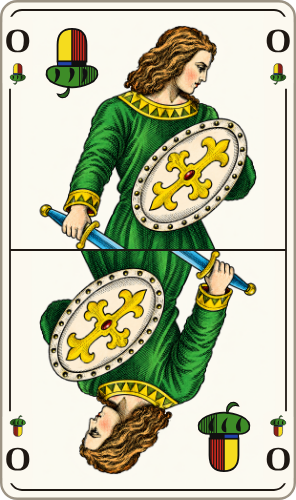
Say “Eichel-Solo”, and Eichel is trump
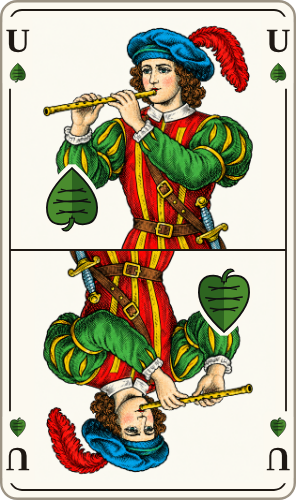
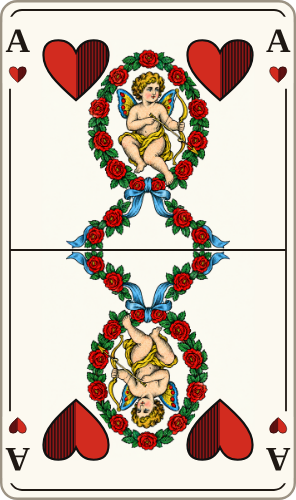
In a Solo you pick a trump suit — say Eichel. Then trump is: all four Ober, all four Unter, and on top the whole Eichel suit from the Sau down. Together 14 trumps — exactly as many as in a Sauspiel.
The only difference from the Sauspiel trump: there Herz is always trump, in a Solo it’s the suit you announce.
The trump ladder is the same
The order of the trumps is exactly as in the normal game: first the four Ober (Eichel, Gras, Herz, Schellen), then the four Unter, and then the suit trumps from the Sau down. The Eichel-Ober is and stays the highest.
And watch out: even the smallest suit trump — the Eichel-Siebner, say — beats any foreign suit, because it’s trump.
No partner, all on one shoulder
Like in a Wenz, in a Solo you play all alone against three — no called Sau, no partner. You need the 61 points all by yourself, the other three hold together against you.
That’s why a Solo is dear: high risk, high reward. How it’s settled comes right up in the next lesson.
A Wenz with a trump suit added
A Farbwenz is a Wenz with a trump suit added: the four Unter plus the whole named suit — eleven trumps. It is announced with the suit: “Herz-Wenz”. And the honour that was not taken out stays in its own suit as a middling trump: in a Farbwenz the trump-suit Ober sits between the König and the Neun.
A Farbgeier is the mirror image: the four Ober plus the suit — and the trump-suit Unter sits in the middle.
Claiming all eight tricks
With a Tout you claim all eight tricks. It doubles the base tariff; Schneider and Schwarz no longer exist — and the hand ends the instant you lose a single trick. Every Tout outranks every non-Tout.
That is how the “official” rules have it — including that a Tout doubles the Laufende too.