Ramsch
When nobody wants it: most Augen pays.
When all four pass, some tables do not scrap the hand — they play a Ramsch: the hand is played out, everyone for themselves, and whoever ends up with the most Augen pays. The goal is upside down.
Open the lesson in the app
And it gets played anyway
A Ramsch is never announced. There is no Ramsch bid and no rank for one — it simply happens when nobody wants to play. The player left of the dealer leads, as always. And there is a second way in: a Hochzeit nobody takes goes the same road at a Ramsch table.
Said plainly: the “official” rules do not mention the Ramsch at all. This is tavern convention — a genuine house rule.
The goal inverts
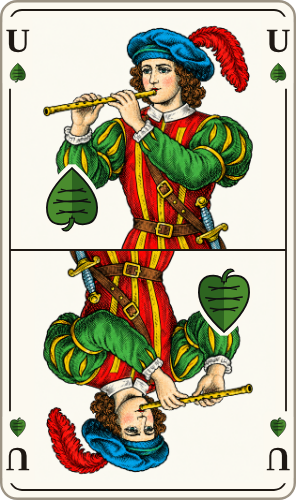
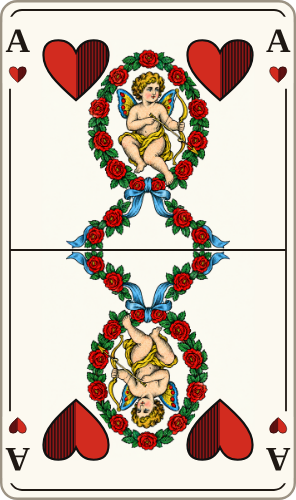
It is played with the Rufspiel trumps: four Ober, four Unter, the whole Herz suit — fourteen of them. You follow suit as usual. But: no Stichzwang (no duty to head a trick, none to trump), no called Ass, no partner, nothing hidden. Every seat is its own party.
Fourteen trumps, eight tricks — and nobody trying to win anything. It is a completely different game with the same cards.
Everything you learned, the other way round
The whole doctrine of the Ramsch in one sentence: if you cannot take the trick cheaply anyway, throw your fattest card into it — not your cheapest. The Augen land with whoever takes the trick, and that should not be you.
And for the same reason: do not trump a fat trick just because you can. You would be taking it — Augen and all.
All eight — and you win alone
A player who takes all eight tricks has made a Durchmarsch and wins the Ramsch alone: they collect from all three.
Here it is all eight and nothing else, and it is never declared — it is noticed. So a Durchmarsch that fails is not a special disaster: you simply hold most of the Augen and pay like anyone else. (Some tables play it with point thresholds or with an announcement — we do not.)
No Schneider, no Kontra, no Laufende
No Schneider, no Schwarz, no Laufende — all of those need two parties splitting 120 Augen between them, and there are none here. And no Kontra, no Re: there is no game to double and nobody to answer.
No Jungfrau either — the Ramsch’s name for a seat that takes no trick at all. At some tables it doubles the price; here we do not play it, and that is a house decision rather than something the rules force. Only the Legen composes: it happened before the auction, and it multiplies a Ramsch like any other hand.
And why two Legen is plenty
The loser pays each of the other three 20 — that is 60 out of pocket. A Durchmarsch collects 50 from each, +150 in total.
These numbers are our own — the sources deliberately leave the money out. And because four Legen make ×16, a Ramsch could cost 960. That is exactly the argument for capping it at two Legen when money is involved.