Legen
Blind, on your first four cards — and it moves only the money.
At some tables the cards are not dealt all at once but in two packets of four. In between, you may say — blind — “I leg.” It makes the hand more expensive, and nothing else.
Open the lesson in the app
The cards come in two packets
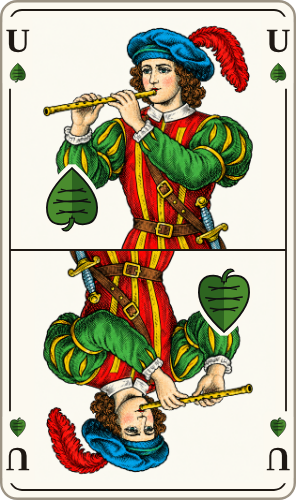
First everyone gets four cards — no more. Then one clockwise round, starting with the player to the dealer’s left: each seat acts exactly once and says “I leg” — or nothing. Then the other four cards arrive and the ordinary bidding begins.
There is no second round and no answering a Legen. It is not an auction — just a tick each player makes alone, before knowing their full hand.
Three names, one rule: Legen, Klopfen, Doppeln. Another table may use a different one — it means the same thing. The two-packet deal is how the “official” rules have it; how much a Legen then multiplies is our own convention.
The money — and nothing else
Each Legen makes the hand twice as expensive: one ×2, two ×4, four ×16. And that is all it does. No party, no contract, no obligation, no signal — legging says nothing about your hand and commits you to nothing.
The commonest misreading: a player who legged neither pays nor receives more than anyone else on their side. The whole table plays for a higher stake — your Legen raises it for the people playing against you too.
A rule of thumb: 2 Ober or 4 trumps
You can see four cards and nothing else. A workable rule of thumb: leg if you hold 2 Ober or 4 Rufspiel trumps (Ober, Unter, Herz). The Ober because they are top trump in every game; the Rufspiel trumps because the Sauspiel is the commonest contract and you do not yet know what will be announced.
A rule of thumb, not a rule. But the one the other players at your table leg by — the numbers above are exactly what the bots compute.
There is no free Legen left
Without Ramsch, a hand nobody bids is a doubled nothing: ×16 of zero is zero. If the table plays Ramsch — and Hochzeit with it — every hand gets played out and paid: four passes open a Ramsch, and so does a marriage nobody takes. That is the single biggest change Ramsch makes to Legen: the hand on which it was free is gone.
So at a table playing for money, a cap of two Legen is a good idea: four Legen on a Ramsch is ×16 — 960 out of the pocket of whoever ate the Augen.